
Understanding Etosha’s habitats
Follow the contrast between pale ground, low vegetation and leafy cover, rather than expecting one uniform safari landscape.
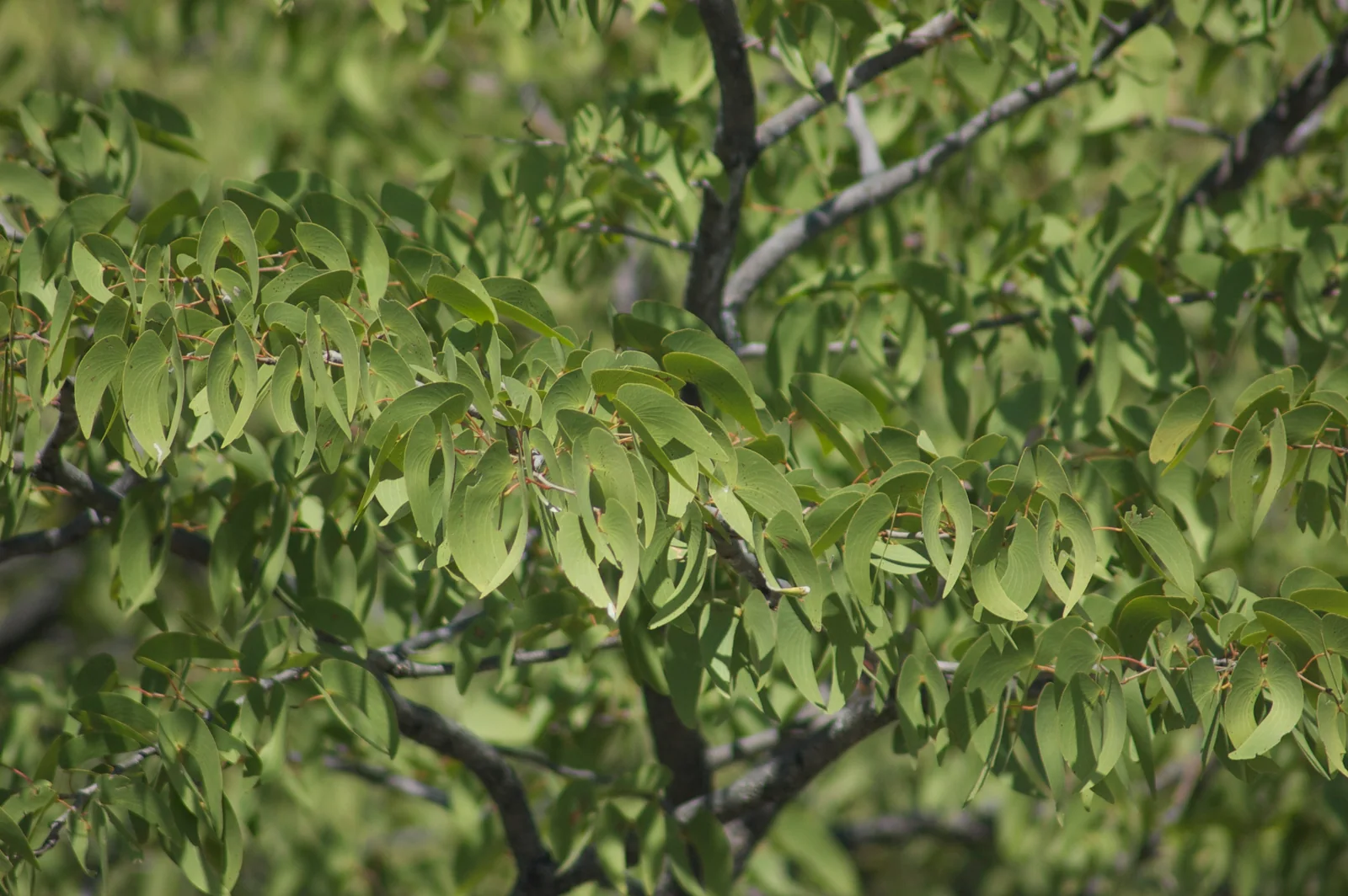

Etosha’s open pan views are memorable, but they are only one part of the park’s visual character. Leafy cover, low shrubs and grassy ground create different ways of seeing. A distant silhouette in an open view asks for a different kind of attention from an animal partly concealed by vegetation.
Start with a small detail
The mopane photograph above gives one botanical detail its own space. It is a documented Etosha image, not a decorative leaf chosen from an unrelated place. Compare the shape and grouping of the leaves with the wider habitat photographs used elsewhere in this guide.
Visit Namibia lists several vegetation types in the park, including mopane shrubland, grass and dwarf-shrub settings, and woodland. These distinctions are a starting point for observation. They do not turn a visitor into a botanist or establish the identity of every plant seen along a route.
Compare three kinds of view
- Open ground: look at the horizon and the distance between visible subjects.
- Keep the scale of the surrounding land in your photographs.
- Allow an unidentified distant shape to remain unidentified.
- Low vegetation: notice the transition between bare surface and plant cover.
- Leafy cover: look at the spaces between stems and branches as well as at the leaves.
Different cover can change how much is visible from one position. An obscured view is a feature of the setting, not a reason to leave a permitted route or approach an animal. Follow current park instructions and the guidance of your operator where applicable.
Choose variety without rushing
You do not need a checklist of every habitat to have an attentive visit. When comparing itineraries, ask which parts of the park they actually include and how the transport arrangements fit the time available. A long list of locations says little about the pace of a day.
The planning guide turns those questions into a practical comparison. If the open landscape is your main interest, begin again at the pan edge and look for the changes around it.